
Press & Media Kit
Resources for journalists, editors, and analysts.
Dargentic Intelligence Issue 02, Brain-Computer Interfaces: The Infrastructure Race, is available at no cost to qualifying institutions: government policy teams, regulatory bodies, speaker bureaus, and tier-one media. Request a review copy at the contact details below. Issue 01 material remains available further down this page.
Issue 02 · Fall 2026 · Published 31 October 2026 · 32 pages · Data to 30 September 2026
BCIs are being priced, coded and regulated before they are sold.
Dargentic Intelligence Issue 02 sets out which channels have opened, how to approach them, and grades the theses of Issue 01.
Issue 02 is a strategy report, not a news digest. It covers the six months to 30 September 2026 in an eight-finding Executive Brief and four agendas by audience, each with a decision and a test, for corporate strategists, investors, marketing and HR leaders, and AI and product leaders.
The world's first approved invasive BCI sold thirteen sets in its first three months of sales. The larger commercial opening came outside the operating room: a developer toolkit, money for brain-data models, a prescription headset used at home and new privacy law. That is where most businesses will meet this technology first. For invasive implants, the institutions are well ahead of the sales.
The report runs to 32 pages in six sections: Briefing, Capital, Commerce, Dargentic View (the Emotion Economy), Governance & Regulation, and Outlook, which closes with a Forward Radar to April 2027 and a scorecard grading eight Issue 01 theses.
Eight findings.
- Businesses can now build on neural input. Meta made its Neural Band toolkit generally available on September 30; Neurable licenses EEG sensing to hardware makers. Apple agreed to buy Sonera’s sensor assets; no product announced. p12
- Feelings are on sale before brain data can prove them. Prophetic takes orders for dream headbands from $449 and Truvaga earned $1.3 million in a quarter selling calm. Ad tools measure emotion from faces and self-reports; the brain-response models we cover are non-commercial or unbuilt. pp18–19
- Brain models arrive ahead of brain devices. Hemispheric trained a model on more than 250,000 hours of EEG and behavioral recordings; Conduit advertises $50 a session to collect its own. p16
- Capital repriced the category ahead of implant sales. Secondary trades reported in July valued Neuralink at $29–42 billion; Precision closed $250 million. pp8–10
- Payment is now the constraint for approved products. China coded its first invasive BCI two days after approval; the United States proposed a Medicare pathway and a procedure code; most developers still face clinical and regulatory gates. p15
- The first disclosed BCI sales record: thirteen sets. Neuracle told the Shanghai Stock Exchange on September 29 that it had 13 sets sold, 8 implanted since July. Each set is listed at RMB 475,000, with no basic-insurance cover (p15). p24
- The brain became a national-security line item. A congressional commission, a White House strategy, a BIS export settlement and two proposed cognitive-warfare mandates arrived by early September. p22
- BCIs can be attacked, and support is not guaranteed. A September preprint set out five families of attack on AI-powered BCIs, from forged signals to backdoored decoders. No supplier we reviewed commits to support beyond its exit. p26
Key figures.
Each figure is shown with its source and, where the report labels one, its evidence grade: measured (regulator, registry, statute, official record, peer-reviewed), company-reported, planned or undisclosed.
13 sold · 8 implanted
Commercial Neuracle NEO sets since July 2026, the first disclosed BCI sales record.
Neuracle Medical, reply to the Shanghai Stock Exchange's first-round review inquiry, 29 September 2026 Company-reported
RMB 475,000
Device list price per NEO set, with no basic-insurance cover.
Neuracle Medical, SSE inquiry reply, 29 September 2026 Company-reported
2 days
From NMPA approval of NEO (13 March 2026) to its national medical-insurance device code (15 March 2026).
NMPA; National Healthcare Security Administration Measured
1 April 2027
Target date for a proposed US inpatient BCI insertion code. A code is neither coverage nor a payment rate.
CMS, ICD-10 Coordination and Maintenance Committee, Fall 2026 ICD-10-PCS materials Measured
250,000+ hours
Of EEG and behavioral recordings behind one model (Hemispheric).
Hemispheric, 15 July 2026 Company-reported
6 US states
With neural-data statutes, two added since April. California's ban on AI tools that collect neural data at work starts 1 January 2027.
State statutes; California AB 1883, 30 September 2026
~150
People implanted with a BCI by June 2026.
A researcher's estimate: Mariska Vansteensel, UMC Utrecht, quoted in MIT Technology Review, 19 June 2026
$2.66B
Neurotechnology capital raised in the first half of 2026.
Neurofounders, "The Neurotech Funding Review H1 2026," 9 August 2026, updated 13 August
Data as of 30 September 2026. Source: Dargentic Intelligence Issue 02.
Quotable.
Quick facts.
Publisher
Dargentic Intelligence
Publication
Issue 02, Fall 2026. Published 31 October 2026
Length
32 pages, six sections
Data cutoff
30 September 2026
Cadence
Twice a year. Issue 03: Spring 2027.
Evidence grades
Key figures labeled measured, company-reported, planned or undisclosed
Independence
No funding or sponsorship from companies covered.
Access
Individual, team and enterprise licenses (free for qualifying institutions)
Sample pages are previews. Review copies of the full report are available on request.
About the analyst.
Velco Dar is the founder of Dargentic Intelligence and the author of NEURAL: How Brain-Computer Interfaces Will Redefine Commerce and Power (Fast Company Press, 2027). He has 20 years of experience in commercial strategy and brand work. Clients include Diageo, LVMH (Moët Hennessy), and Lion.
Velco also publishes InsideBCI, a daily news publication on brain-computer interface industry developments.
Speaking inquiries: bcispeaker.com.
Coverage.

Neuralink and beyond: How BCIs are rewriting the future of human-technology interaction
"What strikes me most is how quickly the big tech players are rushing into BCIs."
Velco Dar, quoted alongside Phil Kennedy (BCI inventor), José del R. Millán (UT Austin), and Noland Arbaugh (Neuralink's first patient).
Read at The Week India →
"When technology democratises expression, society gains more than it loses": Velco Dar
"When technology democratises expression, society gains more than it loses."
Long-form interview by Nirmal Jovial on the commercial and societal implications of brain-computer interfaces.
Read at The Week India →
Join a Velco Dar chat on brain-computer interfaces reshaping how humans connect, work and decide
Time Out Bangkok event feature on Velco Dar's speaking session on the commercial and societal implications of brain-computer interfaces.
Read at Time Out Bangkok →Press kit assets: Issue 02.



How to cite.
Full citation
Dargentic Intelligence. Brain-Computer Interfaces: The Infrastructure Race. Neurotechnology Report, Issue 02, Fall 2026. Published 31 October 2026. https://dargentic.com/reports/issue-02/
Short form
Dargentic Intelligence Issue 02 (Fall 2026)
Previous issue
Dargentic Intelligence. Brain-Computer Interfaces: The Takeoff Era. Neurotechnology Report, Issue 01, Spring 2026. Published 30 April 2026. https://dargentic.com/reports/issue-01/
Previous issue
Issue 01 in one paragraph.
In March 2026, in a world first, a brain-computer interface received regulatory approval for commercial sale. The approval came from China. Issue 01, Brain-Computer Interfaces: The Takeoff Era, is a 29-page analytical assessment of what that means for commerce, governance, and competitive position over the next 18 months. Eight findings. Eight original analytical frameworks. Primary-source operator interviews. Data cutoff 31 March 2026.
Four structural shifts identified in Issue 01.
- BCI is becoming a platform, not a product. Apple's Human Interface Device protocol now recognises thought-based input alongside touch, voice, and keyboard. Distribution will consolidate around platform players within product cycles already underway.
- Value is separating into three commercial layers. Hardware commoditises. Platforms control distribution. The cognitive translation layer, where AI models convert raw neural signal into actionable intent, is where durable advantage will accrue.
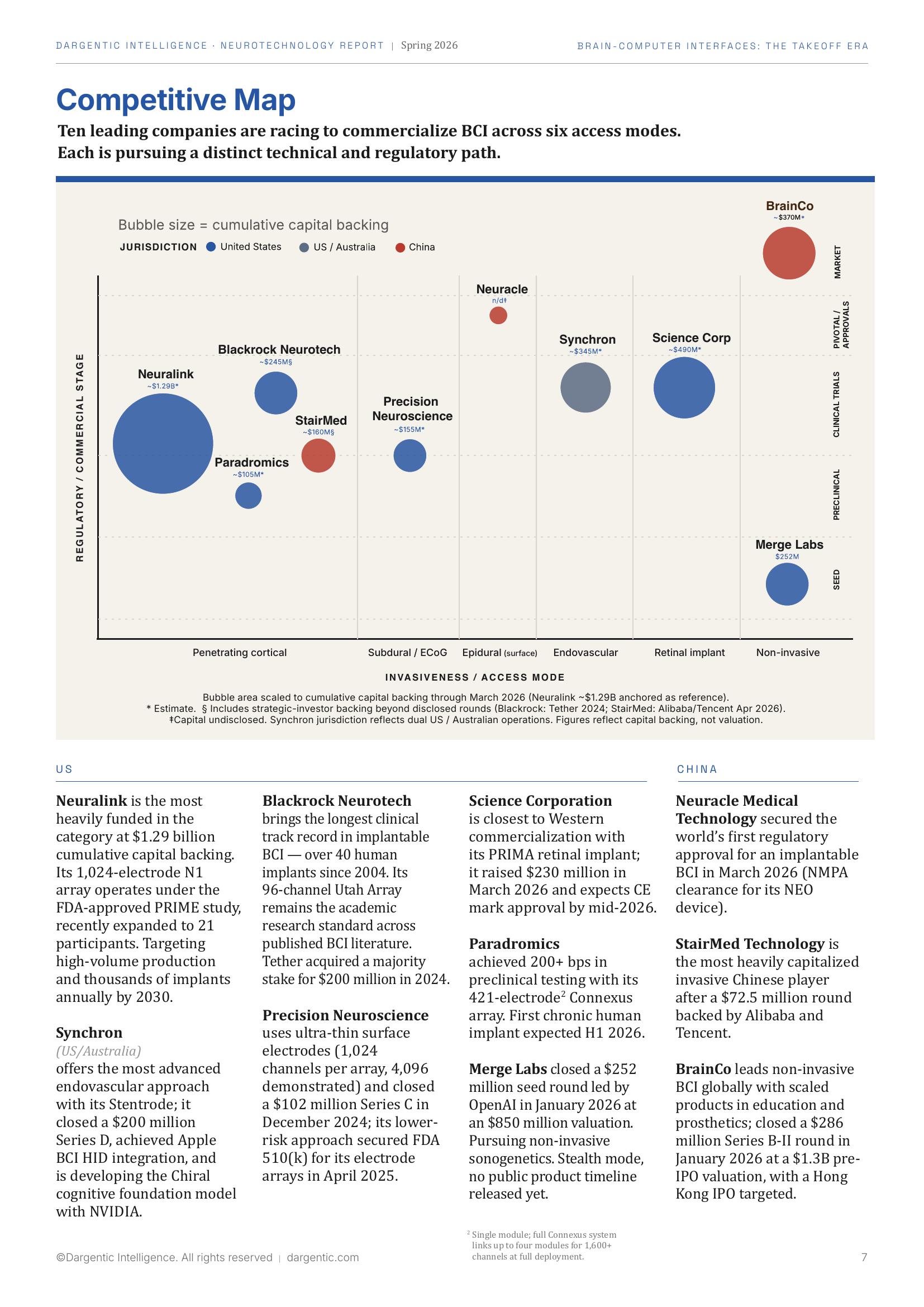
- Jurisdictions are diverging structurally. China holds the only commercial BCI market authorisation on Earth. South Korea's K-Moonshot is building integrated approval, reimbursement, and procurement simultaneously. The United States has FDA approval pathways but zero Medicare reimbursement codes for implantable BCI.
- Regulation is fragmenting at state level. Nine US states have introduced or passed neural data legislation in 2026 alone. A federal floor does not exist. Stanford Law research published March 2026 argues notice-and-consent frameworks are structurally inadequate for brain data.
Publication
Issue 01, published 30 April 2026
Length
29 pages
Data cutoff
31 March 2026
Report page
Quotable, Issue 01.
Press kit assets: Issue 01.
Use, attribution, and embargo.
Findings, frameworks, figures, and direct quotes may be cited in editorial coverage with attribution to "Dargentic Intelligence Issue 02" (or "Dargentic Intelligence Issue 01" for the previous issue). Sample inside pages may be reproduced with the same attribution.
The full PDF is for the requesting journalist's editorial use. It may not be redistributed, posted publicly, or shared with non-credentialed third parties.
If you are working on a story with publication date more than seven days from request, please coordinate with us in advance so we can confirm any data updates or additional context.
Press contact.
For interviews, briefings, review copies, or fact-checks, contact us directly. We respond to credentialed journalist inquiries within 24 hours.